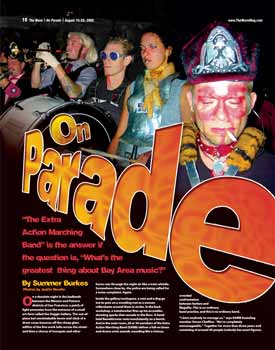
Inside the gallery/workspace, a man and a dog go toe-to-paw on a wrestling mat as a woman rollerskates around them in circles. In the back workshop, a metalworker fires up his arcwelder, shooting sparks that cascade to the floor. A hand-held flamethrower rests nonchalantly on a bench. And in the main room, 20 or 30 members of the Extra Action Marching Band (EAMB) deliver a full-on brass-and-drums sonic assault, sounding like a riotous, crowded confrontation between fanfare and illegality. This is no ordinary band practice, and this is no ordinary band.
“I dare anybody to manage us,” says EAMB founding member Simon Cheffins. “We’re completely unmanageable.” Together for more than three years and consisting of around 40 people (nobody has exact figures), the Extra Action Marching Band has gained a growing local following and stayed together despite (or because of) the lack of a manager, booking agent or pilot of any kind. They are what your high school marching band would be like if they were 15 years older, anti-establishment, leaderless, chemically altered, oversexed, unconcerned with formation and discipline, soul-fired, funk-drenched, aggressively hedonistic and prone to bouts of complete f*cking insanity. Their uniforms almost match, their flag girls (and boys) are comically slutty and each gig can be more aptly described as a “takeover.”
“If we’re going to go out for at least one gig,” says bass drummer Bob Evil, “we’ll play somewhere else: the next bar down the road, somebody we know who’s throwing a party, whatever.” Besides playing both expected and unexpected gigs at various parties, clubs and parades, the band has orchestrated impromptu sets at a taqueria, a BART station, an unsuspecting Filipino family’s kitchen and the Tonga Room at the Fairmont hotel. They usually opt to play among the crowd rather than on a stage. When the band finishes and marches off, they often have a Pied Piper effect, the crowd trailing behind them out the door to see what’s going to happen next.
“We rock people, and they don’t expect it,” says trumpet player Daryl Henline, in the understatement of the year. “And when we give it, it’s a huge gift - to the audience and to us. As a musician, it sucks to go play gigs on a Monday night at some club with eight people there all posing and trying to be cool.”
“It’s way more interesting to throw yourself into a situation that’s totally unpredictable,” continues Bob Evil. “In the world we live in nowadays, there are few visceral, immediate experiences. Music, TV, movies, even books – there’s a lot of mediation, distance and alienation between the artist and the audience. I think that’s why people really get into what we’re doing. Some of the best moments in anybody’s life are complete and total surprises. It’s the same for us.”
“This band is nothing new,” says Henline. “Some of our musical influences are new but... we’re just a village band. All through history, musicians have kind of been the shit-class of people – they aren’t merchants, they’re not bankers, they never own homes, stuff like that – but they help people rock. In that way, we’re fairly close to religion, but we’re way better than religion, cuz we’re free.”
“It’s the religion of wine, women and song,” says Bob Evil.
“It’s an ecstatic, itinerant ritual to chaos,” says trombone player Ben Furstenberg.
“This band is about two things,” says Wiley Evans, sousaphone player. “Endurance and having as much fun as possible. During performances we cross the invisible line that has traditionally separated the audience from the performer. It creates a sense of chaos and synchronicity all at the same time.”
“So when we play,” says Henline, “it’s really important that we have lots of drinks. It’s important that the crowd hand us drinks. We’ll drink anything they hand us. I’ve drunk urine by mistake. And in Tucson two of our band members drank white gas.”
Tough Ship
As if holding down a giant marching band wasn’t enough extracurricular activity, the EAMB is also working on a Burning Man art project of staggering proportions. “We’re doing a really over-the-top, enormous, incredibly complicated project called ‘La Contessa,’” says Mateo, bullhorn-player and band babbler. “It’s a 40-foot-long, 19-foot-high, motorized 16th-century Spanish galleon. It was conceived by Simon (Cheffins).” (Artist Cheffins’ previous works include a transparent bathtub and a waterfall that folds up into a suitcase.)
“We’ll be driving the ship around on the playa, and it will be a stage, among other things,” says Mateo. “We’re over budget as it is, and we’re desperately in need of volunteers. Please put that in your article. We’re looking for volunteers – carpenters, welders, hard workers - who are willing to work for nothing more than a meal.”
Burning Man, and parties like it, spawn hundreds of volunteer-driven, cash-poor, done-at-the-last-minute, fantastical and wonderful art projects each year. In a world that’s increasingly roped off into suburbs and cubicles, art – at least in the Bay Area – is becoming more interactive and visceral. The line between participant and spectator is blurring. Like many folks in the Bay Area arts scene, most members of the Extra Action Marching Band tend to see life and work as the same thing, and work and art, and life and art, and if they make money off it, then cool, and if they don’t, they’ll find some other way. Possessing the polar opposite of hip-hop’s bling-bling mentality, they are proud of the scrounge and the obtainium. In their private lives, they enjoy a communal, anti-materialistic environment (members of the band live together in warehouses in Oakland); in performances, they revel in jumping folks unlike themselves off the grid for a second, giving them a flash of the Other; the freaks. If the Situationists were less abstruse, or if Ken Kesey’s Merry Pranksters were less self-congratulatory, or if the Master Musicians of Jajouka were comedy, or if the Cacophony Society were a musical group... the Marching Band are not the first, just one of the latest manifestations of art-driven, participatory catharsis. Somehow, too, they embody the pre-lingual cave-days of banging bones together ‘round the fire – but with more sex, and cool uniforms.
Chaos-ification
So, in a 40-odd-member band with no leader, how do things like building a giant motorized 16th-century Spanish galleon ever get accomplished?
“We have a very non-linear dynamic system,” says Bob Evil. “You can visualize that by imagining an elephant caught up in telephone wires and trying to struggle free. The more we try to organize what goes on, the less goes on. The more hands-off, the better it is.”
Killashandre, glockenspiel player: “This band runs on chaos theory. It takes a while to filter a thought through the band - it’s the hive-mind problem. There’s actually an official lag-time: anywhere between half an hour and two hours.”
Mateo: “It takes a long time to organize. It’s not a democracy, it’s not a dictatorship, it’s not a consensus, it’s not quite anarchy...”
Bob: “It’s kind of like herding cats.”
Killashandre: “It’s hard to get started, but it’s really hard to stop, too. Cops find that out.”
Though one or more members have been affiliated with latter-day drum-freakout group Crash Worship, the EAMB eschews the ideas of status, hierarchy and celebrity. Their individual musical resumes range from inexperienced to overqualified, and their genres of choice are as varied as San Francisco’s gene pool – but, thankfully, the Marching Band requires neither musical purity nor instrumental virtuosity.
What’s your musical background?
Bob Evil: “My personal background is West African.”
Furstenberg: “I played a bunch of rock and experimental stuff.”
Henline: “I like to think of myself as a collegiate musical hack of all trades.”
Evans: “I hold a degree in Music Performance from SFSU and a masters in Music Composition from the California Institute of the Arts.”
Boni, snare: “I started in fifth grade. I was in high school marching band, college marching band and then DCI [Drum Corps International]. And Simon here is a big fan of AC/DC, ZZ Top and Pink Floyd.”
Van Rippen, pole drum: “I have none, actually, and until I met the marching band, I didn’t know shit.”
Showtime
The night after rehearsal, at Chicken John’s “Rock the Boat”– an unlikely and marvelous gig at Kelly’s Mission Rock in which most of the performances take place on boats floating in the Bay – the Marching Band’s members trickle in one-by-one and somehow, finally, gather at the land-locked starting point. (What other bands have a “starting point”?) Alcohol is consumed, instruments are hoisted and a bass drum pounds quietly, calling. EAMB followers and curious first-timers flock to the band like moths to flame, even before anything starts.
“Look out – we’re LOADED!” a flag girl warns, screaming, twitching, hands in the air and eyes popping. A single trumpet oozes a sound stolen straight from Harlem; the rest of the brass transforms it to a slow, New Orleans back-alley funeral procession dirge. The band eases into it, all kinda rubbing against each other like horny monkeys as they warm up. Crowd members are all too eager to join in the sway. Pom pom girls give folks the carwash treatment, and Mag-Lites from crowd participants illuminate the band on the deck by the water, horror-movie style.
A single snare paradiddle starts the ignition, and the music kicks into high gear. The pulsing throng shifts with the weight of the Marching Band pressing into them, pressing forward – and absolute, grinding, sweaty mayhem commences. Standing at close range, our ears are pleasantly attacked, sending the ancient signal to the brain that something’s coming for us. The band maneuvers like salmon upstream to the middle of the downstairs by the Bay and have what would be a drum circle if drum-circle people used sticks and horns more – and if drum circles didn’t suck.
Many band members sport wigs far less ridiculous than their own hair, and the flag team can’t resist sticking their asses out and shimmying into whatever. As usual, the flag team becomes the focus. Please, flag team, knock something over. Kick someone in the head. Hump something until you cum. Pass out from drink and euphoria – that’s what the crowd wants to see. This is the NASCAR of music, and we watch and wait for the crash. Legendary composer and percussion enthusiast Carl Orff, if he were alive, would hire the Extra Action Marching Band for his children’s birthday party. Or a porno.
Cameras flash and roll from all encroaching sides and an impromptu circle is formed so that nobody gets smacked in the head with a drumstick (much). Boni bangs on the snare like a Benihana chef, resplendent in custom silver breastplate, hot pants, mink stole, cigarette dangling from her mouth. Violet Angel, another percussionist, furrows her brow and taps cowbells in time, taking signals from Cheffins, sweating under her marching band coat. Horn players round out the second circle and smoke as they play. A particularly salacious song starts bumping and two flag girls standing on a table get topless and have conniption fits, throwing things and nearly kicking folks in the face. People in the crowd rub against each other and whatever else is on hand. It’s like when dogs see their masters having sex and then start humping the furniture. “Umm, I want to BE them,” says a bystander dressed like a pirate.
After the gig, band members stumble around and hug crowd members and each other like they’ve just performed the show of their lives – but this is what happens after every show. Amp the crowd like that, and one is bound to be pleased with oneself. It has to be addictive. One percussionist wanders past the security guards, checking tables for half-drunk beers. He downs a couple. Then the message gets filtered through the hive-mind that The Wave Magazine wants to gather the band for a group photo.
It’s kind of like herding cats.